


LTA Proposes Merging COE Categories A and B: What Singapore Car Buyers Need to Know

Singapore's Certificate of Entitlement (COE) system could be heading for a major change. The Land Transport Authority (LTA) has proposed combining COE Categories A and B into a single passenger car category, alongside a new system of rebates and surcharges based on a vehicle's Open Market Value (OMV).
Announced on 8 October 2026, the proposal aims to better distinguish between mass-market cars and higher-value vehicles as advancements in automotive technology make the current COE classification less effective.
If implemented, the changes could affect how Singaporeans buy new cars, compare vehicle prices and plan their next car purchase.
However, the proposal has not been finalised. LTA is gathering public feedback until 2 November 2026, with its findings and recommendations expected in the first half of 2027.
Here is what Singapore car buyers should know about the proposed COE changes and how they could affect future car ownership decisions.

What Are COE Categories A and B?
A Certificate of Entitlement (COE) gives a vehicle owner the right to register and use a vehicle in Singapore for 10 years, subject to the relevant requirements. COEs are allocated through a bidding system, with premiums influenced by demand and the available quota.
Under the current system, passenger cars are divided into different COE categories.
Category A COE generally covers smaller, less powerful cars that meet the prevailing engine capacity or power output criteria. It is commonly associated with mass-market models.
Category B COE generally covers larger or more powerful cars, including many premium and luxury models.
The distinction was introduced to help separate mass-market vehicles from higher-end cars. However, changes in vehicle technology have made this classification increasingly challenging to maintain.
For buyers, the difference between Category A and Category B COE premiums can significantly affect the overall cost of purchasing a car in Singapore.
Why Is LTA Proposing a COE Category A and B Merger?
According to LTA, advances in vehicle technology, particularly the growth of electric vehicles (EVs), have made engine capacity and power output less effective in distinguishing between mass-market and higher-value cars.
Electric vehicles do not have conventional engine capacity in the same way as petrol-powered cars. Their power output can also be configured to meet existing Category A requirements, allowing some higher-value models to qualify for Category A COEs.
As a result, more buyers are competing for Category A COEs, narrowing the price gap between Categories A and B.
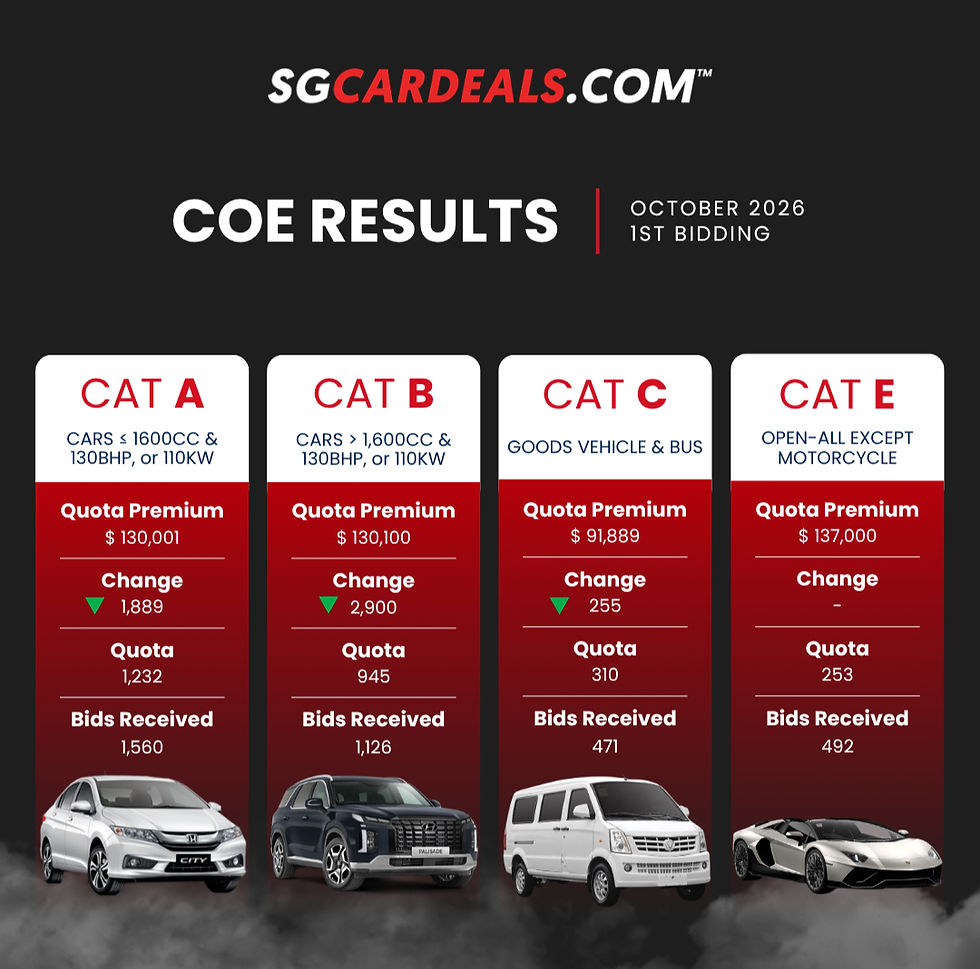
Between February and June 2026, Category A COE premiums exceeded Category B premiums on three occasions.
This has raised questions about whether the existing COE framework continues to achieve its original objective of differentiating mass-market cars from higher-value vehicles.
By reviewing the classification system, LTA hopes to maintain a more meaningful distinction between the two segments while allowing COE premiums to continue being determined by market demand and supply.
How Would the Proposed COE Merger Work?
Under LTA's preliminary proposal, Categories A and B would be combined into a single passenger car COE category.
Instead of bidding separately for Category A or Category B, buyers of passenger cars would compete within the same COE pool. A common prevailing COE premium would then apply, subject to a vehicle-specific rebate or surcharge determined by its OMV.
The proposed system is known as a fee-and-rebate system, or “feebate”.
The objective is to keep lower-value cars relatively more affordable while requiring buyers of higher-value vehicles to pay more.
1. One COE Category for Passenger Cars
If the proposal proceeds, passenger cars currently classified under Categories A and B would compete for COEs in one combined category.
This would replace the existing separation based on engine capacity and power output.
For car buyers, this means that the prevailing COE premium would no longer be determined separately for the current Category A and Category B segments.
However, the final amount payable for an individual car would depend on the adjustments introduced under the proposed feebate system.
2. Rebates for Lower-Value Cars
Under the proposed system, cars with lower OMVs could qualify for a rebate on the prevailing COE premium.
This could help reduce the COE cost for eligible mass-market models, potentially supporting buyers who are looking for a more affordable car in Singapore.
The actual benefit would depend on the vehicle model's assigned OMV band and the final rebate structure adopted by LTA.
3. Surcharges for Higher-Value Cars
Cars with higher OMVs could face an additional surcharge on top of the prevailing COE premium.
The aim is to preserve a meaningful price difference between mass-market vehicles and higher-value models, even if both groups compete within the same COE category.
Under the preliminary options, the maximum rebate or surcharge would be S$15,000 per vehicle. This would create a potential difference of up to S$30,000 between vehicles at opposite ends of the proposed adjustment structure.
These amounts are proposed adjustments, not confirmed charges that buyers must pay today.
What Is Open Market Value (OMV), and Why Does It Matter?
Open Market Value, or OMV, is an important part of Singapore's vehicle taxation framework.
It represents the assessed value of an imported vehicle before local taxes and registration-related charges. The assessment takes into account the purchase price, freight, insurance and other relevant costs associated with importing the vehicle into Singapore.
OMV is already used in calculating a vehicle's Additional Registration Fee (ARF).
Under LTA's proposed COE feebate system, the median OMV of a particular car model would be used to determine its adjustment band. This median would be calculated from the OMVs of past registrations of the same model over a specified period.
The assigned band would determine whether a car receives a rebate, has no adjustment, or incurs a surcharge.
LTA has proposed reviewing and publishing the band assignments annually so that buyers can understand the applicable adjustments before making a purchase. Car retailers would also have the opportunity to appeal a vehicle's assigned band.
For consumers, this means that the model's value could become an even more important factor when comparing the overall cost of different cars.
The Two COE Feebate Options Proposed by LTA
LTA has outlined two possible approaches for structuring the rebates and surcharges: a three-band system and a five-band system.
Option 1: Three-Band System
The simpler approach would divide car models into three OMV bands.
Proposed band | COE adjustment |
Lowest OMV band | S$15,000 rebate |
Middle OMV band | No adjustment |
Highest OMV band | S$15,000 surcharge |
This structure would be easier to understand and administer. However, the difference in treatment between models in neighbouring bands could be relatively large.
Option 2: Five-Band System
The alternative would use five bands to provide more gradual adjustments.
Proposed band | COE adjustment |
Lowest OMV band | S$15,000 rebate |
Second OMV band | S$7,500 rebate |
Middle OMV band | No adjustment |
Fourth OMV band | S$7,500 surcharge |
Highest OMV band | S$15,000 surcharge |
This approach would create smaller differences between adjacent bands, although the administration of the system would be more complex.
Both options are preliminary proposals. The final band thresholds, applicable adjustments and implementation arrangements will depend on the outcome of LTA's review.
How Could the COE Merger Affect Car Prices in Singapore?
The proposed merger could affect buyers differently depending on the vehicle they intend to purchase.
Buyers of Mass-Market Cars
Buyers of eligible lower-OMV models could benefit from rebates that reduce the amount payable above the prevailing COE premium.
This may make certain smaller or more affordable cars more attractive. However, the final impact on the total purchase price would also depend on the COE premium, vehicle price, taxes, dealer pricing and other costs.
A rebate does not automatically guarantee that a car will become cheaper by the full rebate amount, as market conditions and vehicle pricing may change.
Buyers of Higher-Value Cars
Buyers of higher-OMV models could face surcharges under the proposed system.
This could increase the cost of some premium vehicles and influence the affordability of certain models, including higher-value electric cars that currently qualify for Category A COEs.
Anyone considering a premium vehicle should therefore compare the complete cost of ownership rather than looking at the COE premium alone.
Buyers Considering Electric Vehicles
Electric vehicles are an important part of the discussion because their power output and other specifications can make the existing Category A and B distinction less effective.
If the merger proceeds, some EV buyers may see different COE adjustments depending on their chosen model's OMV band.
Buyers should not assume that every electric vehicle will become more expensive or cheaper. The outcome would depend on the model's assigned band, the prevailing COE premium and the final policy.
Existing Car Owners
The proposal may also be relevant to existing owners who are deciding whether to keep their current car, sell it or replace it with another vehicle.
However, the effect on existing vehicles and COE renewals will depend on the final arrangements. LTA is seeking feedback on whether the proposed feebate system should also apply to COE renewals.
Owners should therefore avoid making a decision based solely on the assumption that the new system will definitely be implemented in its current form.
Should You Buy a Car Now or Wait for the COE Changes?
With the proposed COE merger still under review, there is no single answer that suits every buyer.
The right decision depends on your current transport needs, budget, existing vehicle and how soon you need another car.
Consider Buying Now If You Need a Car Soon
If your current car is nearing the end of its COE, your family needs another vehicle, or you require a car for work, it may not be practical to delay your purchase indefinitely.
Rather than relying on a proposed policy change, compare current vehicle prices, prevailing COE premiums, financing costs and the total amount payable.
You can also compare new and pre-owned vehicles to see which option best fits your budget.
Consider Waiting If Your Purchase Is Flexible
If you do not need a car immediately, monitoring the consultation outcome and upcoming COE bidding exercises may help you make a more informed decision.
However, waiting does not guarantee lower prices. COE premiums can rise or fall depending on demand, supply and bidding behaviour, while vehicle prices and financing conditions may also change.
The proposed merger should be treated as one factor in your decision rather than a guarantee of future savings.
Compare the Total Cost Before Making a Decision
When evaluating a car purchase, consider more than the advertised price or COE premium.
Important costs include:
The vehicle's selling price and applicable taxes.
The prevailing COE premium and any applicable adjustments.
Downpayment and monthly instalments.
Insurance premiums.
Road tax, servicing and maintenance.
Depreciation and the expected resale value.
Comparing these costs across different models can help you understand which car offers better value over your intended ownership period.
What Happens Next for Singapore's COE System?
LTA's public consultation opened on 8 October 2026 and is scheduled to close at 11.59pm on 2 November 2026.
The authority is seeking feedback on whether Categories A and B should be merged, how the feebate system should be designed, and whether the adjustments should apply to COE renewals.
LTA is also seeking views on how Category E, the Open Category COE, should be adjusted if Categories A and B are combined.
Other ideas raised during earlier discussions include providing more support for families with young children, introducing surcharges for multiple-car ownership, creating a separate COE category for private-hire vehicles, and allowing buyers to bid directly for COEs.
These are separate suggestions and should not be mistaken for confirmed policy changes.
LTA expects to complete its review by the end of 2026 and publish its findings and recommendations in the first half of 2027.
Until then, buyers should continue monitoring official announcements rather than assuming the proposed system will take effect immediately.
Stay Updated on COE Prices and Car Market Trends with SGCARDEALS
Singapore's proposed COE changes could influence how buyers compare car prices and plan their next purchase. However, COE premiums, vehicle prices and financing conditions remain important factors in determining whether a car is affordable.
At SGCARDEALS, we help car owners and buyers explore their automotive options, whether they are planning to purchase a vehicle, sell their existing car or compare available services.
If you are thinking of changing your car, start by understanding its current market value and comparing your options before making a decision.
Looking to sell your car in Singapore? Get a free car valuation from SGCARDEALS and find out what your vehicle could be worth in the current market.
Visit SGCARDEALS to explore our car-selling services and take the next step towards your car ownership plans.
Disclaimer: This article is for general informational purposes only and does not constitute financial or purchasing advice. The proposed COE changes may be revised following public consultation. Refer to official LTA announcements for the latest policy details.


Comments